Website
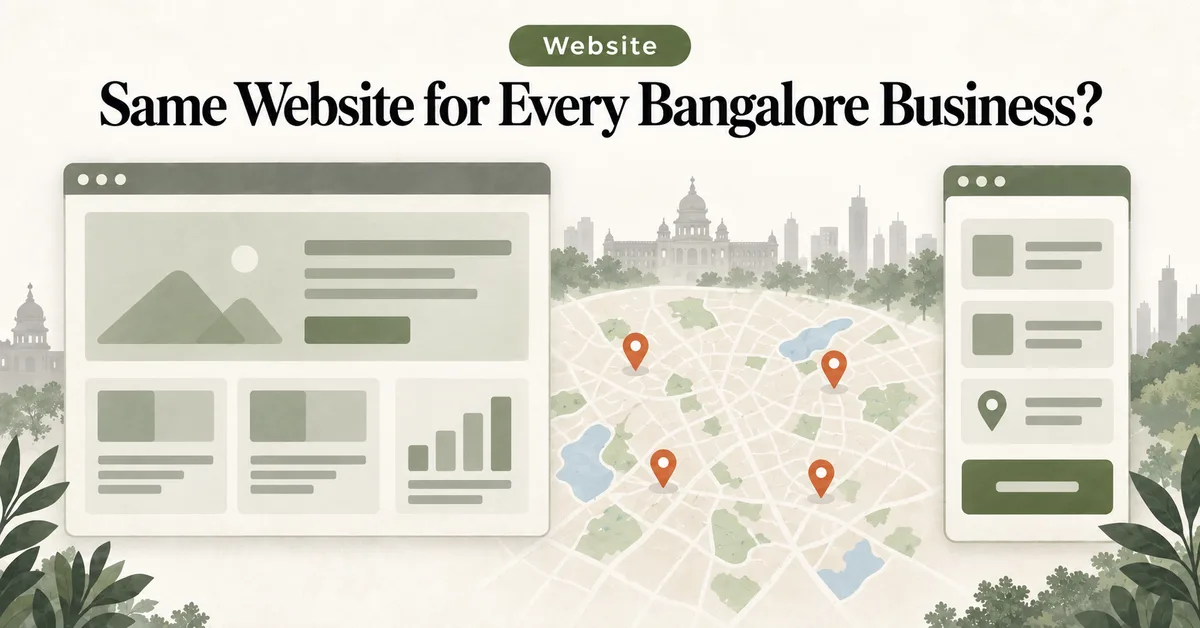
Does Every Bangalore Business Need the Same Kind of Website?
The Short Answer Is No
Ask most web design agencies for a quote and you will usually get the same site back, whatever the business — a homepage, an about page, a services grid, a contact form, styled differently each time but built the same way underneath. For a lot of businesses that is fine. For a lot of others it quietly costs them the one visitor who mattered.
We build in six Bengaluru neighbourhoods now, for two different services, and the honest answer to “do all these businesses need the same kind of site?” is no — not because we like variety, but because the businesses themselves are not asking for the same thing.
Two Buyers, Two Builds
The clearest version of this split shows up in Koramangala. A funded startup there is building a site to survive an investor’s or an enterprise buyer’s due diligence — a clear product narrative, real case studies, a conversion path built for a considered decision, not a same-day purchase. A café two streets away needs the opposite: fast, mobile-first, simple enough that someone finds the menu in seconds. Build the startup’s site for speed and simplicity and it reads as under-built to an investor. Build the café’s site with enterprise-style content structure and the mobile customer gives up before finding today’s specials.
We now apply one test before starting any build: who is actually deciding, and what do they need to see before they act? An investor reads a homepage differently than an enterprise procurement team does, and both read it differently than someone standing outside your shop trying to find your number.
What This Looks Like Area by Area
Real differences, not decoration, once you look at the businesses that actually operate in each area:
- In HSR Layout, the SaaS and startup teams mostly need a self-serve site — a product tour and signup flow, not a pitch deck — while the clinics need appointment booking that works from a few sectors over.
- In Electronic City, enterprise and B2B buyers are doing considered research over weeks, so the site needs case studies and spec-level detail; the restaurants and clinics serving the area’s commuting workforce need something that books or orders in a few fast taps.
- In Whitefield, the functional complexity is the story — admissions portals, appointment systems, property listings — because the businesses there run on function, not just presentation.
- In Indiranagar, discovery is visual first, so the build leans on photography and portfolio layout over dense text.
- In Malleshwaram, our own neighbourhood, reputation carries as much weight as anything on the page, so the site has to carry credentials and testimonials, not just load fast.
- In Koramangala, it is the fundraising-ready build against the fast local one, described above.
When One Template Genuinely Is Enough
None of this means bespoke everything, every time. A generic template is the right call when a business is genuinely generic to itself — a single-location service with one kind of customer, one decision to make, and nothing area-specific worth saying. The mistake is assuming that is true by default rather than checking it against who the site actually has to convince.
The Question We Ask Before We Start
- Who is the buyer, really? An investor, an enterprise procurement team, and a walk-in customer read a homepage completely differently.
- What do they need to see before they act? Credentials and case studies for a considered decision; hours, location and a menu for an immediate one.
- What does the area itself add? A sector number, a phase, a reputation that already precedes you — real, checkable facts, not invented flavour text.
- Would swapping in a different business break the page? If the answer is no, the page has not actually been scoped to the business yet.
If you are weighing this for your own business, the useful first question is not what a website should look like but who has to be convinced by it. Our website development team works through that with businesses across Bengaluru before a single page is designed, and our SEO team applies the same area-by-area discipline on the search side — we wrote about that test in do you need a separate page for every Bangalore neighbourhood.
Not sure what your site actually needs?
That is the first thing we work out on any build. Book a free 30-minute consultation with our website development team — no pitch, just an honest read of what your business needs and what it does not.
Book a Free Consultation →