SEO
Do You Need a Separate Page for Every Bangalore Neighbourhood?

The Short Answer Is Usually No
Ask an SEO agency for help with local search and sooner or later someone proposes a page for every neighbourhood you could conceivably serve. SEO in HSR Layout, SEO in Jayanagar, SEO in Yelahanka, and so on down the list: fifty pages, one template, the area name swapped each time.
Sometimes that is smart. More often it is the fastest way to build a site that Google learns to ignore. The honest answer to “do I need a page for every neighbourhood?” is usually no, and it matters that you know why, because we have been on both sides of this decision.
What Our Own Grid Taught Us
Our old WordPress site had exactly this structure. Roughly a dozen service variants across fourteen Bengaluru areas came to about 181 pages, with addresses like /best-seo-services-in-koramangala-bangalore/ and /content-marketing-services-malleshwaram/. When we rebuilt the site in July we deleted every one of them and redirected them into our 13 location pages.
The reason was simple. Put any two of those pages side by side and you could not find a difference beyond the area name. Google’s spam policies call that pattern doorway abuse: pages created to rank for a run of similar searches, each adding little for the person who lands on it. Whether or not a penalty was ever coming, the pages were not doing a real job for anyone.
The Swap Test
Here is the test we now apply to every area page. Take the page, replace the area name with a different neighbourhood, and read it again. If it is still true, the page is not about the area. It is a template.
A page passes only if it contains things that cannot be swapped: how people in that area actually search, which businesses actually operate there, what your real connection to the area is, and questions that only make sense for that place. Our own rule is that at least 40 per cent of a page has to be genuinely specific to the area, or we do not build it.
Bangalore Makes This Easier and Harder
The good news is that Bengaluru’s areas really do search differently, so a page can have something true to say.
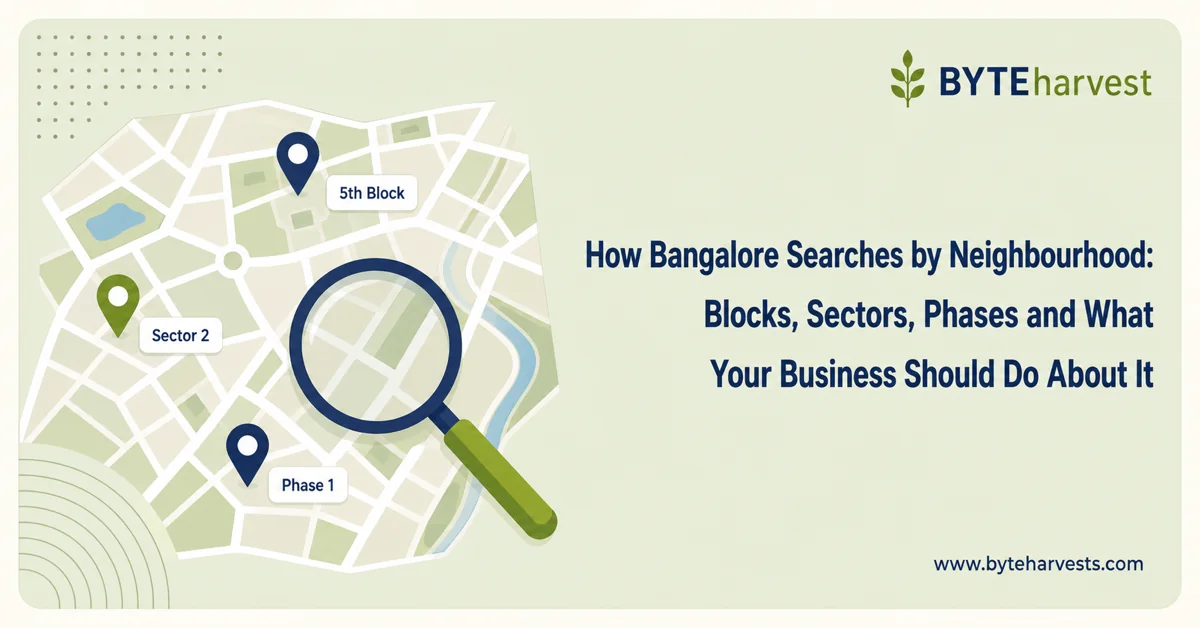
- In HSR Layout, people search by sector, and “Sector 2” and “Sector 7” describe different journeys even though both are HSR.
- In Electronic City, the split is between Phase 1 and Phase 2, and a large share of the business is enterprise and B2B rather than walk-in.
- In Whitefield, the area is too large for its own name to carry a search. People use landmarks and sub-localities instead.
- In Koramangala, a funded startup competing nationally and a café competing for one block share a postcode and almost nothing else.
- In Indiranagar, discovery is visual first, so photos and reviews matter more than classic keyword work.
- In Malleshwaram, our own neighbourhood, reputation and search carry roughly equal weight.
The harder news is the flip side. Where two neighbourhoods a few kilometres apart search the same way and serve the same customers, one page covering both beats two thin ones. We wrote up the vocabulary differences in more detail in how Bangalore searches by neighbourhood.
When a Page Per Area Is Worth Building
- People there search differently. If the vocabulary is the same as the next area over, you have nothing new to say.
- You genuinely serve the area. That means customers, staff or a real presence, and something true you can say about it. Never invent local clients or claim an office you do not have.
- The service is searched with an area name. Not every service is. Check Search Console or autocomplete for your own service before building anything, because a page for a search nobody makes is wasted effort.
- You can pass the swap test. If you cannot fill the page with things that are specific to the area, do not publish it.
- You can build it in stages. Start where your customers actually are, and expand only when the results justify it.
How We Approached It
We tiered our areas. The places with the most business density came first, plus Malleshwaram regardless of volume because it is where our office is. Areas we could not justify with data were left for later, and a few we expect never to build. We also tiered our services, because some are searched with an area name and some are not.
We built three pages first and waited to see whether Google indexed them before building more, then added the rest. None of our case studies names a specific neighbourhood, so none of our area pages pretends to have local clients. Nine of these pages are live today. They were indexed within a day of going live, but whether they rank is something only months of data can answer, and it is too early to claim anything.
What to Do Instead if You Serve Many Areas
- One strong page that names the areas you serve honestly, linking only to area pages that are genuinely distinct.
- A properly set-up Google Business Profile, which does much of the “near me” work without a page for every locality.
- One page for neighbouring areas that search alike, rather than a thin page for each.
- Slow, evidence-led growth. Add a page when the data or your customers justify it, not because the template makes it cheap.
If you are weighing this for your own business, the useful first question is not how many pages to build but which areas genuinely deserve one. Our SEO team works through that with businesses across Bengaluru, and it is worth doing before a single page is written. If you are earlier in the process, our note on technical SEO versus local SEO is a good place to start.
Which areas deserve a page?
That is the first thing we work out on any local SEO engagement. Book a free 30-minute consultation with our SEO team — no pitch, just an honest read of where a page would help and where it would not.
Book a Free Consultation →