Strategy
How Bangalore Businesses Search by Industry
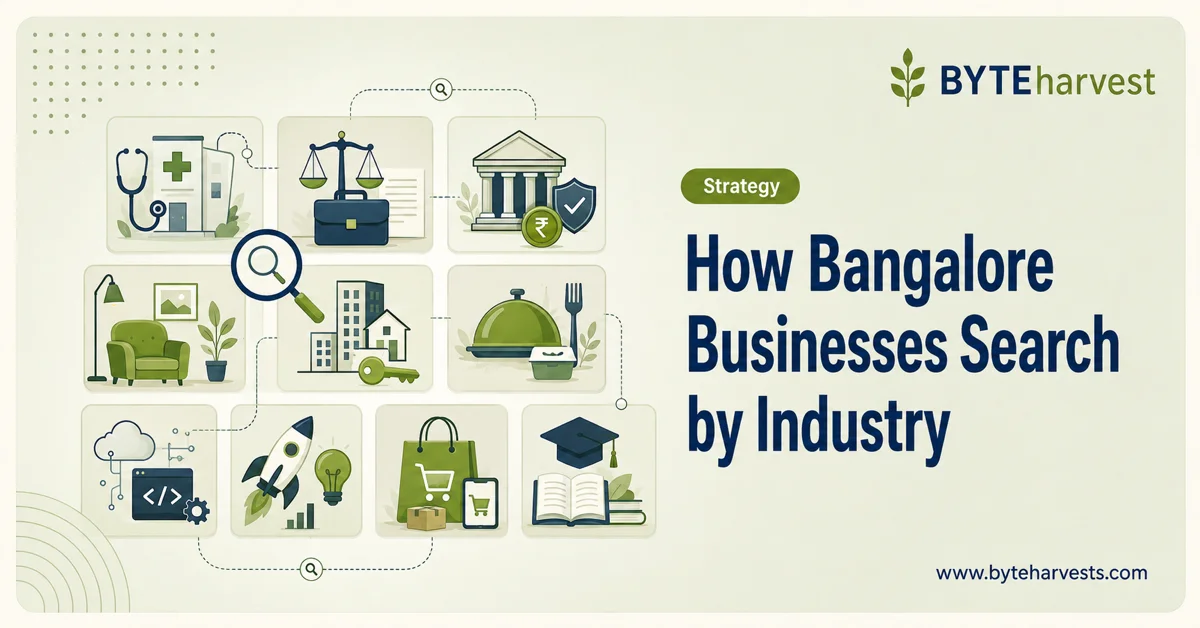
Ask two founders what “good marketing” looks like and, if one runs a clinic and the other runs a SaaS company, you will get two different answers — and both will be right, for their business. The mistake is not picking the wrong tactic. It is assuming the same tactic works everywhere.
We build for ten different industries out of Bangalore, and the pattern that stands out most is not which channel wins — it is how differently “winning” is even defined from one industry to the next. Some businesses need to be found. Some need to be trusted before the first call. Some need to be seen doing the work, not told about it.
This is a practical look at those differences, drawn from what we see building for each one, and what it should change about how you spend your marketing budget.
The trust-first industries
Some purchases get researched to death before anyone picks up the phone. If you sell into one of these categories, your marketing job is mostly done before the enquiry ever arrives.
Healthcare and clinics are the clearest example. Nobody chooses a doctor the way they choose a restaurant. By the time someone searches for a clinic, they have usually already decided the category and are now vetting the specific provider — reviews, credentials, how the practice is spoken about online. The job is to be the clinic patients trust before they call, not to win the click. A slick ad that leads to a thin, generic page does more harm here than no ad at all.
Legal and corporate consulting works the same way, for higher stakes and a longer research window. Clients choosing a lawyer or an adviser are evaluating judgement and discretion, not price. Generic service pages and aggressive advertising signal the opposite of what the buyer is looking for — the content has to build the authority that wins high-value enquiries, which is a slower, more deliberate exercise than most performance-marketing thinking accounts for.
FinTech, BFSI and insurance sits in the same family for a different reason: nobody makes a financial decision on impulse. Every query we see for this category (marketing and solutions searches, specifically, not generic finance content) has the shape of someone doing careful due diligence before committing to anything. Credibility-led content — not persuasion — is what actually moves this category.
The show-don't-tell industries
Other categories are decided visually, and no amount of copy will substitute for proof.
Interior design is the purest version of this. A portfolio page with real, specific work outperforms any amount of persuasive writing, because the entire purchase decision is “do I like what this person makes.” The job here is genuinely to let the work do the selling — the marketing role is getting good work in front of the right eyes, not arguing for it.
Real estate is adjacent but with a harder conversion goal: turning a property search into a qualified site visit. Developers, brokerages and consultants are all competing for the same searchers, and the deciding factor is rarely the ad — it is whether the listing and the follow-up actually match what was promised. Marketing that overpromises here creates its own churn, because the mismatch shows up at the site visit, not the click.
The fast-decision, local industries
Then there are categories where the whole cycle — search, decide, act — happens in minutes, not weeks.
Restaurants, cafés and cloud kitchens are the clearest case. Local discovery has to convert into a table booked or an order placed, right now, on a phone, often while the person is already hungry. Photos, wait times, delivery radius and how recently a review was posted matter more here than almost anywhere else on this list — the research phase other industries rely on barely exists.
The considered-purchase, longer-cycle industries
At the other end of the spectrum are the categories where the buyer knows this will take a while and is not in a hurry to be sold to.
SaaS and technology businesses deal with complex products and genuinely long buying cycles — the real search demand we see for this category (queries like “SaaS tech marketing in Bangalore”) reflects a market that already knows it is shopping for a specialist, not browsing. The marketing job is building a predictable pipeline, which means nurturing a qualified prospect over months, not chasing a single conversion event.
Startups are related but earlier-stage: the goal is turning early traction into something sustainable, which usually means sharper positioning before more spend, not the other way round. A startup that increases ad budget before it has fixed its message is paying to amplify confusion.
E-commerce and D2C brands sit closer to the fast-decision end but still deserve their own category — the searches we see (people specifically looking for D2C-focused marketing help, not generic e-commerce advice) tell us the buyers already know their problem is product discovery and conversion, not brand awareness. Performance, content and conversion strategy have to work together here, because none of the three alone moves a D2C business on its own.
The seasonal, pipeline industry
Schools and education don't fit neatly into any of the categories above, because the calendar does more work than the channel. Admissions has real seasons, and a campaign that performs brilliantly outside them is still a wasted campaign. The job is filling an admissions pipeline with the right families, which means marketing that respects the calendar as much as it respects the message.
What changes beyond the channel mix
The categories above change more than which platform gets the budget. A few things shift with them:
- In the trust-first industries, the page itself has to do more work than the ad. Sending paid traffic to a thin page wastes the budget you spent earning the click.
- In the show-don't-tell industries, photography and case-study depth are not a nice-to-have add-on — they are close to the entire marketing asset.
- In the fast-decision, local industries, response speed matters as much as visibility. A restaurant that ranks well but answers WhatsApp slowly is still losing the booking.
- In the considered-purchase industries, a single-touch campaign will always underperform a nurture sequence, because the buyer was never going to convert on the first visit.
- In the seasonal industry, timing the spend to the calendar is worth more than almost any creative decision made within it.
None of this is exotic. It is the difference between marketing that assumes every buyer behaves the same way, and marketing built around how your specific buyer actually decides.
A practical checklist
If you want to act on one thing this week:
- Name which category you're actually in. Not your industry label — the *decision pattern* above. A clinic and a law firm both sell trust; a restaurant and a startup do not share a decision cycle at all.
- Match the asset to the pattern. Trust-first needs depth on the page. Show-don't-tell needs a real portfolio. Fast-decision needs speed of response, not more copy.
- Stop measuring every industry the same way. A SaaS lead nurtured over three months and a restaurant booking made in three minutes should never be judged against the same conversion window.
- Budget for the cycle length you actually have, not the one that's easiest to report on. Considered-purchase categories need sustained spend to see a fair read; fast-decision ones need almost none.
- If you're a professional-services or healthcare business, read our guide to online reputation management — trust-first industries live or die on what people find when they search your name.
Where to start
Pick the one pattern above that matches your business, and check whether your marketing is actually built for it — not adapted from a generic playbook or borrowed from a competitor in a different category entirely.
You can see how we approach each industry on our Bangalore industries pages.
Want help putting this into practice?
This is everyday work for our team, working across ten industries in Bengaluru. Book a free 30-minute consultation — no pitch, just an honest view of what would move the needle for you.
Book a Free Consultation →